
Somat Clinic offers its clients a new behavioral optometry service where it is investigated how the brain, eyes, and body work together to make sense of the information that comes through the eyes.
For this, we have the necessary technical and human resources so that the patient can not only achieve good visual acuity, but also develop and improve the visual skills needed to achieve more effective visual performance in daily life activities: at school, workplace, sports, or other recreational activities.
A personalized evaluation (visual efficiency and perception) will be carried out, adapted to the visual health and age of each patient (babies, children, and adults), by an Optometrist specialist in Behavioral Optometry.
What is behavioral visual therapy?
There are certain visual conditions that cannot be adequately treated with glasses or contact lenses, yet they are better resolved through a visual therapy program.
Behavioral visual therapy is a neurofunctional treatment, consisting of a program of personalized and individualized activities according to the specific needs of each patient. Suitable for both children and adults.
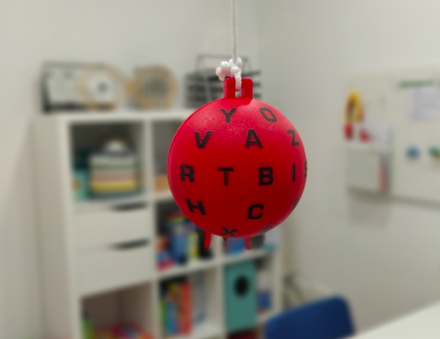
Unlike other visual therapies, the goal of using behavioral visual therapy procedures is to achieve optimal teamwork between the eyes and the brain, so that new, more efficient and precise neural networks are created. The result is an effective visual system in any situation, whether academic, work-related, or leisure. Consequently, greater performance, concentration, attention, and confidence, with less effort, less tension, fewer symptoms, and therefore HIGHER QUALITY OF LIFE!
How is visual therapy performed?
After estimating the duration of the visual therapy program, the patient is scheduled weekly for sessions to perform the activities together with the therapist. Additionally, exercises for home are planned, which are fundamental for the success of the visual therapy program.
In the case of a pediatric evaluation, the baby’s developmental level from birth can be assessed and it can be verified whether visual development milestones are being reached. Additionally, families are advised with guidelines for proper visual stimulation in the baby.
The activities used in a behavioral visual therapy program vary according to age, level of development, or the visual needs and objectives of each person.
The therapist uses a variety of tools, devices, and games in each procedure, aiming to make them enjoyable for the patient. Likewise, instruments such as the balance board, trampoline, rocker, among others, are gradually added to achieve good integration with movement, balance, hearing, rhythm, etc.
How do I know if I would benefit from the visual therapy service?
We recommend that you schedule an appointment with the behavioral optometrist for a comprehensive evaluation of vision and eye health if you are concerned about your vision, your child’s, or another family member’s. These are some of the cases or symptoms in which we can help:
- Amblyopia
- Strabismus
- Low concentration
- Lack of attention
- Difficulty recognizing letters or words
- Lack of fluency in reading
- Skipping words or lines when reading (uses finger to read)
- Low reading comprehension
- Sleepiness when reading
- Difficulty writing (disorganized, slanted, uneven spacing)
- Difficulty copying from the blackboard.
- Spelling mistakes
- Difficulty with math
- Eye fatigue in the office and computer. Near task fatigue
- Headaches after near work or workday
- Double vision
- Frequent eye rubbing
- Closing or covering one eye when reading
- Squinting to see clearly
- Poor coordination and clumsiness
- Difficulty in team games and ball sports
- Incorrect distance calculation
- Difficulty going up/down stairs
- Dizziness when moving (car, bicycle, etc.)
- Feeling that the surrounding world is unstable
- Different visual quality after trauma.
- Dyslexia, ADHD, among others
- Sports performance